Many martial artists would cherish the opportunity to own even just a small item representing Japan’s Budo history and culture. This is not only possible but often can be done at a reasonable cost. And by reasonable I mean tens-to-hundreds of dollars. Where can these treasures be found? For a start, at several of Tokyo’s flea or antique markets. Here are four golden rules for buying, what to buy, and where to go.
Rule 1. Don’t worry about getting ripped off. The stories you’ve heard about Japan are true. The concept of honor is pervasive in Japanese society. My personal experiences include leaving an IPAD on a subway train; my daughter left her $225 Gi on a train; a friend left a wallet on a bench in Tokyo Station; and another friend left a $4,000 camera at a busy restaurant. All were returned to a lost and found office within 24 hours. Yes, I’m not kidding or exaggerating. So, while in life you can never be 100 percent sure; your chances of being ripped-off buying a martial arts antique are very, very low.
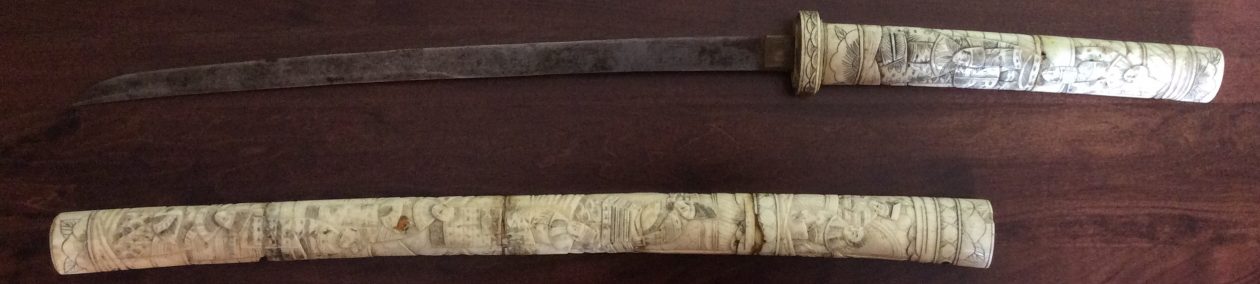
Rule 2. Understand what you are buying. While people won’t intentionally rip you off it is easy to get a bad deal by not knowing what your are doing. For example, something like a 400 year old katana is not likely going to be complete from that time period. The cord wears out over time as does the handle. The same is true for the cords and leather on armor. It was quite common for samurai to replace equipment parts over the centuries as the object was passed from generation to generation.
Rule 3. Don’t haggle – at least not too much. You can certainly ask for a discount. People will often offer one without even asking, but aggressive haggling on price is a bit insulting. Be respectful even when haggling.
Rule 4. If you don’t speak Japanese and plan to drop a few hundred bucks you may want to bring a translator. My weak Japanese is nowhere good enough to understand what people were telling me about the history of an object.
Martial Arts antiques to buy:
I’ve noticed consistently three types of martial arts antiques at many (certainly not all) Japanese flea markets: samurai equipment; ninja equipment; and historical art works.
The samurai equipment is usually weapons or armor. f you are going to invest big bucks in something like an antique katana you should most definitely go to a dealer. The Japanese government requires ownership papers and an export license. These documents also ensure authenticity. Your katana dealer will almost always prepare both these documents for you for a small fee (mine was about $100 USD). If he does not, go to another place.
As for the flea markets, I picked up this Yari (spear) at the Ohi Racetrack market for about $60 USD. It dates back to the early Edo Period – 1600’s. This particular spear tip used by soldiers (or samurai) is triangular. A triangular blade stronger that a flat sided one and would have done better penetrating the armor of the day. Experts debate whether the wound was more difficult to treat but those discussions are limited to bayonets in the modern era.
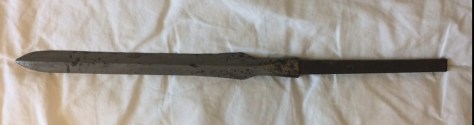
As the pictures demonstrates there is some rust as well as wear. And yet it is — for me — an extraordinary piece of history and Budo culture.
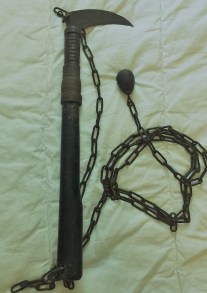
Antique Ninja weapons are also at available at flea and antique markets but there are not always so common. I purchased a Kurasigama that dates to the mid 1800’s. Due to the welds on the chain and number on the ball; those components were most likely added in the late 18th Century. I have seen the same object (with the same welds and number on the ball) on display in a museum here.
Of course by the late 1800’s ninjitsu was on the decline so one has to wonder what this was used for and by whom?
Budo Art
Another Budo antique readily available in Japanese flea and antique markets are wood block prints. Each of these prints dates from the mid-1800’s and depicts samurai and battle scenes. In that time in history many events and people were still captured by artists (although the camera soon replaced them). I purchased these for $20 USD to $100 USD (the colored one) each. When framed, they present a martial artist with a visual insight into the Budo culture of that day.


Places to go:
Ohi Racecourse Flea Market
My favorite Tokyo flea market. This is also known as the known as the Tokyo City Flea Market. It is time consuming to get to but is also one of the biggest and most popular flea markets, with around 600 vendors. That figure varies a lot depending on the weather. It has a regular schedule unlike other flea markets in the Tokyo area.
Where: Ohi Racetrack, Shinagawa (it’s near Oikeibajo Station).
When: Every Saturday and Sunday, 9am-3pm
Yoyogi Park Flea Market
Yoyogi was long home to of Tokyo’s oldest and most hipster-ish flea markets. 800 vendors, all peddling second-hand goods – with lots of recycled fashion. I found a late Edo period samurai helmet there for about $480 USD. The schedule is a little erratic because different groups run these flea markets. Check Yoyogi Park’s schedule page for the next one (use Google Itools to translate).
Where: The paved space just across from the park itself, near the NHK buildings (near Harajuku Station). It is about a 10 minute walk from exit 1 of the Station.
When: Sundays, usually once a month … maybe.
Heiwajima “Antique Fair”
Touted as the oldest and most famous antique fair in Japan. It has 280 dealers and is held five times a year. They don’t only sell antiques—you can find much of the same kind of stuff as you would at a regular flea market.
Where: Ryutsu Center Building, 2F (in front of Ryutsu-Center Station/Monorail line).
When: 5 times a year-three days each time. Check the website (in English!) for dates.
Boro Ichi Market
This is one of the more fun markets you can visit in Japan. The Setagaya Boro-ichi Fair has been a popular fair since was it started about 440 years ago. “Boro” refers to old fabric scraps, which was the main item traded at the fair in the past. The fair is even hosted on “Boro Street”. Today the event is popular with tens of thousands of shoppers. It is a lively atmosphere with 700 vendors selling everything from food and clothes to plants and katanas. The martial artist will find a variety of interesting collectibles including: antique “Tsuba” (the hand guard on a katana); replica katana, and tanto (short knife), and occasionally helmets and some parts of samurai armor.
Where: Tokyo, Setagaya 1-chome, Setagaya-ku. Boro-ichi dori (street)
When: Twice per year in mid-December and mid-January
More places to shop: Temples and shrines are not a great place for martial arts antiques but you can still get a lot of interesting stuff. All flea markets are help on Sundays.
Arai Yakushi Temple 新井薬師アンティーク・ フェア Every 1st Sun. 【6:00 am – around 3:30 pm】 5-3-5 Arai, Nakano-ku, Tokyo
Nogi-jinja Shrine 乃木神社 骨董蚤の市 Every 4th Sun. except Nov. 【9:00 am – around 4:00 pm】 8-11-27 Akasaka, Minato-ku, Tokyo
Hanazono-jinja Shrine 花園神社 青空骨董市 Every Sun. 【around 6:30 am – around 3:00 pm】 5-17-3 Shinjuku, Shinjuku-ku, Tokyo
Tomioka Hachiman-gu Shrine 富岡八幡宮 骨董市 Every 4th & 5th Sun. 【6:00 am – around 5:00 pm】 1-20-3 Tomioka, Koto-ku, Tokyo
Gokoku-ji Temple 護国寺骨董市 Every 2nd Sat. 【7:00 am – 3:00 pm】 5-40-1 Otsuka, Bunkyo-ku, Tokyo
Takahata Fudoson Temple 高幡不動ござれ市 Every 3rd Sun. 【7:00 am – 4:00 pm】 733 Takahata, Hino-shi, Tokyo
A martial artist has a unique opportunity when visiting Japan to acquire and forever have a part of Japanese Budo history and culture.





 Martial Arts of Japan